National Spaghetti Day
About National Spaghetti Day
When is National Spaghetti Day? This holiday is always observed on January 4
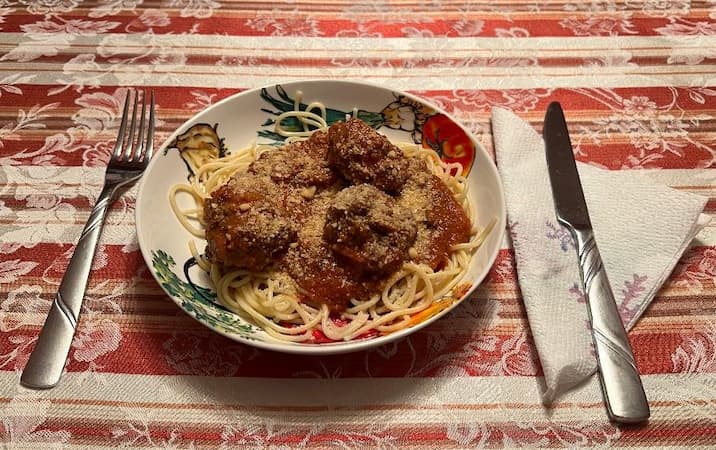
Today is National Spaghetti Day, a January 4 holiday. Grab a big bowl, fill it with spaghetti, and top it with a generous helping of your favorite sauce. Then, dig in. And, don’t forget the meatballs and parmesan cheese! Spaghetti is one of over 600 shapes of pasta. It is by far, the most popular shape. Spaghetti is topped off with any one of 15 types of sauce. Marinara sauce is the most popular.
Of course, many people think of Italy and Italian cuisine, as the birthplace of spaghetti. In reality, pasta or macaroni dates back to ancient times. Ancient cultures were cooking pasta noodles well before they were introduced to Italy and other parts of Europe. Marco Polo is erroneously credited with bringing spaghetti and pasta to Europe. But, records show Europeans cooking pasta well before Marco Polo began his travels. Peering even farther back in time, Arab cultures were selling dried spaghetti-like noodles in open markets in the early 1200s. The Chinese were cooking pasta noodles as far back as 5,000 B.C.
While ancient cultures were making and eating spaghetti and other pasta well before it came to Europe, it’s the Italians who popularized it in cuisines. It was introduced into the United States through the travels of Thomas Jefferson, who brought it back from Naples, Italy in 1789. Italian immigrants also brought it over with them to the U.S., where its popularity quickly spread.
Spaghetti in Italian means thin string or twine.
On a National Spaghetti Day, we hope you thoroughly enjoy your bowl of Spaghetti today. To more completely enjoy this special day, make the spaghetti noodles yourself. It’s a cinch. All you need is flour, water, and a pasta maker.
Who Invented Pasta?
There are competing beliefs as to who was the first to invent pasta.
Ancient Chinese consumed pasta as early as 5,000 B.C.
First, in Greek mythology, the god Vulcan used a device to make strings of dough. The exact date is unknown.
Second, the city of Palermo, Italy also claims to have created pasta in the 12th century. Interestingly, at the time spaghetti was not topped with a tomato-based sauce. Tomatoes are native to South America. The New World had not yet been discovered.
Arabs also claim to be the first to make pasta. Their claim also goes back to the 12th century.
Spaghetti Trivia
Enjoy this spaghetti trivia as you twirl strands of pasta around your fork.
- Spaghetti is just one form of pasta.
- There are over 600 shapes of pasta.
- It is a high-carb meal. One cup of spaghetti contains 40 to 44 grams fo carbs.
- The word originates from the Italian word “spaghetto” It means a thin string or twine.
- Italians do not use a fork when twirling spaghetti onto their fork. The use of a spoon is an American custom.
- Without a doubt, Italians eat the most spaghetti. The average Italian consumes over 50 pounds of pasta per year.
- Comparatively, Americans eat on average 20 pounds per year.
- On October 20, 2010, Lawson Inc. from Tokyo, Japan produced the world’s longest strand of spaghetti. It was 12,388 feet 5 inches long.
- The world’s largest meatball was cooked in Pozzilli, Italy. It weighed 2,014.7 pounds. Please pass the Parmesan cheese.
- Thomas Jefferson introduced pasta to the United States.
- There are gluten-free varieties of spaghetti.
- In addition to wheat, spaghetti is also made from barley, beans, corn, and rice
Ways to Participate in National Spaghetti Day
Celebrating this food holiday is both fun and filling. Here’s how you can have fun today:
- Eat Spaghetti. Have it with your favorite sauce.
- Experiment with a sauce you’ve never had before.
- Hold a special dinner. You know what to serve.
- Use a pasta machine to make your own spaghetti.
- Then, make your own sauce and meatballs, too.
- Post pictures of spaghetti and meatballs on social media.

Today's Quote
“When you really want to show some love, keep the flowers and say it with spaghetti.” – – Rachael Ray
History and Origin of National Spaghetti Day
We researched this holiday twice, once in the early 2000s, and again in the early 2020s. Despite our extensive research efforts, we found no information on the creator or origin of this day, or when it was first celebrated.
There is no evidence to suggest that this is truly a “National” day, which requires an act of Congress. We found no congressional records or presidential proclamation about this special day.
Definition of “National” Days – Find out why it is important to distinguish true National days.
This Day in History
In addition to National Spaghetti Day, here are some things that happened on this day:
- Columbia University is founded as Kings College in New York City. (1754)
- Samuel Colt sells his first revolver pistol to the U.S. government. (1847)
- Isaac Newton, Astronomer, Physicist, Mathematician, was born on this day in 1643.
Related Holidays
Additionally, if you like National Spaghetti, you will also like:
More January 4 Holidays
Here is another January 4 holiday we are sure you will enjoy:
More About Today
This Day in History – Indeed, many other important events occurred on this date. See what happened on this date in history.
Famous January Birthdays – Did you ever wonder what famous people share your birth date? If so, then find out now!
Ecards – Send a free Ecard daily for National Spaghetti Day or just about any calendar holiday, occasion, observance, or event. Undoubtedly, it’s fun for both the sender and the recipient.
Flower of the Day: Butterfly Flower
Today’s Recipe: Candy Cane Cookies – use up leftover candy canes
Holiday Insights, where every day in January is a holiday, a bizarre or wacky day, an observance, or a special event. So, please join us in the daily calendar fun each and every day of the year.
Did You Know? Furthermore, in addition to National Spaghetti Day, there are literally thousands of daily holidays, special events, and observances, more than one for every day of the year. and many of these holidays are new. People and organizations are creating new holidays regularly. January holidays are no exception. Consequently, at Holiday Insights, we take great efforts to thoroughly research and document the details of each one, as completely and accurately as possible.