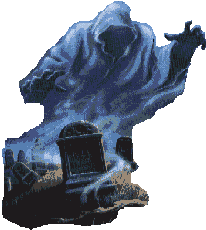
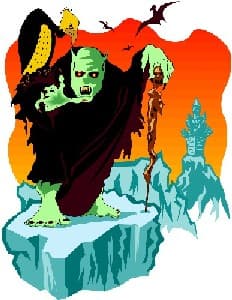
Samhain was known in Ireland as the “Lord of Darkness”. The Druid religion was practiced by ancient Celtic tribes that populated Ireland and parts of Europe. This religion worshipped Samhain, the Lord of Darkness. Some writings also speak of Samhain as the “Lord of the Dead”. But, today’s scholars suggest that this is incorrect.
The Druid New Year began on November 1st. It is also known as the “Feast of Samhain”. The Celts only recognized summer and winter seasons. Translated, Samhain means “Summer’s End”. At this time, the hours of nighttime were growing significantly over the hours of sunlight. Hence, Lord Samhain reigned over the long winter months as the influence of the Sun god and the summer season (Beltaine or Beltane) preceded. Samhain’s influence grows with the increase in the hours of darkness. He can only roam the earth during hours of darkness.
The Druid’s New Year’s Eve was Hallow E’en, (also called Hallowmas). The Druids believed that on this night, all of the people who died in the past year would rise up and search for the passageway to the netherworld. On this night the passageway or “veil” between both worlds was its thinnest. Lord Samhain would roam the earth in search of these souls to capture them and take them to his world of darkness. To this day, some people put lights in their windows to help the dead find their way and keep Lord Samhain away from taking them.
Samhain Trivia: Originally, Samhain was not represented by an evil spirit. Rather, the word stood for an ancient harvest festival. The Gaelic word “Samhain” means “end of harvest” or “summer’s end”
The Roots of Halloween
The Druid religion, dating back to about 200 BC, had priests and priestesses. These magicians (soothsayers or wizards) filled the most important roles in Celtic culture. At the time, the Celtic tribes were close to nature. As a result, they worshipped many objects of nature as their gods. No Druid god was more powerful, nor more feared, than Lord Samhain.
The roots of Halloween are traced back to the Druid religion and Lord Samhain. Certainly, Halloween took aspects of darkness, black color, evil spirits, and people rising from the dead and roaming the earth on this night. These themes of Halloween are all common with this religion.
Pope Gregory II moved the Christian holiday of “All Hollow’s Eve” from May 13 to November 1st to coincide with the Feast of Samhain. All Hallows Eve honored the saints of the church. Moving the date of All Hallows Eve was an attempt by the Roman Catholic church to downplay the pagan festival. Hopefully, they reasoned, it would replace Samhain and the pagan celebration would fade away.
The pagan festival continued to be celebrated, and Halloween evolved largely from it. Today, the Catholic church tolerates Halloween, recognizing it is a fun holiday and not intended to hold religious or other supernatural beliefs or religion.
Halloween Trivia: The 1960’s Television show Bewitched featured a lovable and good witch named Samantha Stevens. As for her mother, however……
Fortune Pumpkin – Altogether, here is a different way to get an online fortune cookie.
Holiday Insights, where every day is a holiday, a bizarre day, a wacky day, or a special event. Thus, please join us in the fun every day of the year.
Did You Know? All in all, there are literally thousands of holidays, special events, and observances, more than one for every day of the year. Many new holidays are being created on a very frequent basis. Consequently, at Holiday Insights we strive to thoroughly research and report details of each one as accurately as possible.
We hope you enjoyed this article on Samhain, the Lord of the Dead. Please tell your friends about us.